Humboldt-Universität zu Berlin – Institut für Kulturwissenschaft
Déborah V. Brosteaux
Associated Researcher
Georgenstr. 47
10117 Berlin
Deborah.brosteaux@ulb.be
Déborah V. Brosteaux is a postdoctoral researcher at the Université Libre de Bruxelles. She is also a member of the CREG (Centre de Recherche sur l’Expérience de Guerre, ULB-MSH) and the Marc Bloch Centre Berlin, and she teaches at Sciences Po Lille.
Her current postdoc project Affective legacies. The possibilities of a non-fascist life in New German Cinema addresses the question that engaged an entire generation after the Second World War and has continued to haunt us ever since: How can one lead a non-fascist life when the history and culture on which we depend appear to be deeply compromised by the crimes that plague them? How can this legacy be transformed – and what stories must we inherit to do so – in order not to perpetuate its violence? This project develops a concept of affective legacy that enables us to reflect simultaneously on the processual and recurring dimensions of violent legacies, as well as on legacy as a space from which transformative potential and intimate counterforces can be drawn. To develop this reflection, the project turns to the experimental cinema of the first post-war generation in West Germany; specifically, films that shape and reflect the perspective of the children of those who brought Hitler to power. The project develops an atmospheric approach to legacy: violent legacies circulate along pathways that are both situated and embodied, yet also diffuse and impersonal. The project examines the formal aspects and aesthetic techniques of film insofar as they shape affective legacies and their potential for transformation.
Her doctoral thesis in philosophy (defended in 2023), under joint supervision by the Université Libre de Bruxelles and the University of Wuppertal, was published in 2025 by Éditions du Seuil under the title Les désirs guerriers de la modernité. The dissertation takes the contemporary Western European context as its starting point and draws on various insights into the 20th century to examine the structures of affect and desire associated with war, the interweaving of which has shaped the rhythms of modernity. Drawing on Walter Benjamin’s philosophy of sensory perception in modernity, and building on the work of W. G. Sebald, Klaus Theweleit and a comprehensive study of Ernst Jünger, the thesis examines the First World War, the interwar period and the post-war era in Germany. It analyses the historical forms of the rhythms, sensibilities and intensities through which these affects and desires take shape. On this basis, it explores several scenes: the desire for an intensification of the experience of the self, which marks the imaginary landscapes of 1914–1918; the clearing of the rubble after 1945; and the dynamics of ›coldness‹ in the distancing from the violence of war – as well as the active relationship to war that is inherent in this distance.
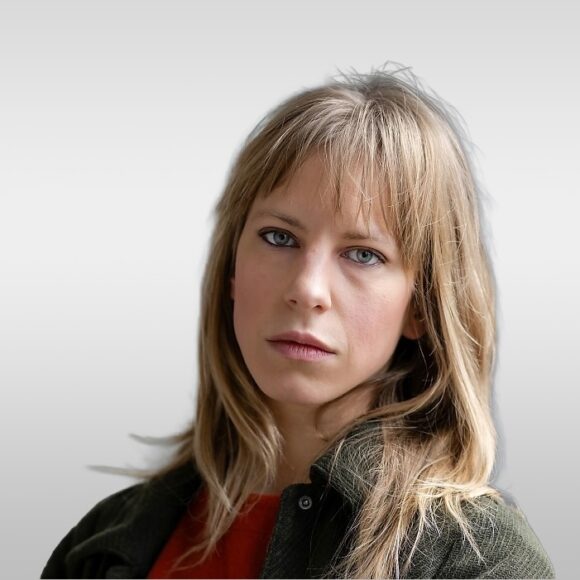
Déborah V. Brosteaux
Associated Researcher
Georgenstr. 47
10117 Berlin
Deborah.brosteaux@ulb.be
Déborah V. Brosteaux is a postdoctoral researcher at the Université Libre de Bruxelles. She is also a member of the CREG (Centre de Recherche sur l’Expérience de Guerre, ULB-MSH) and the Marc Bloch Centre Berlin, and she teaches at Sciences Po Lille.
Her current postdoc project Affective legacies. The possibilities of a non-fascist life in New German Cinema addresses the question that engaged an entire generation after the Second World War and has continued to haunt us ever since: How can one lead a non-fascist life when the history and culture on which we depend appear to be deeply compromised by the crimes that plague them? How can this legacy be transformed – and what stories must we inherit to do so – in order not to perpetuate its violence? This project develops a concept of affective legacy that enables us to reflect simultaneously on the processual and recurring dimensions of violent legacies, as well as on legacy as a space from which transformative potential and intimate counterforces can be drawn. To develop this reflection, the project turns to the experimental cinema of the first post-war generation in West Germany; specifically, films that shape and reflect the perspective of the children of those who brought Hitler to power. The project develops an atmospheric approach to legacy: violent legacies circulate along pathways that are both situated and embodied, yet also diffuse and impersonal. The project examines the formal aspects and aesthetic techniques of film insofar as they shape affective legacies and their potential for transformation.
Her doctoral thesis in philosophy (defended in 2023), under joint supervision by the Université Libre de Bruxelles and the University of Wuppertal, was published in 2025 by Éditions du Seuil under the title Les désirs guerriers de la modernité. The dissertation takes the contemporary Western European context as its starting point and draws on various insights into the 20th century to examine the structures of affect and desire associated with war, the interweaving of which has shaped the rhythms of modernity. Drawing on Walter Benjamin’s philosophy of sensory perception in modernity, and building on the work of W. G. Sebald, Klaus Theweleit and a comprehensive study of Ernst Jünger, the thesis examines the First World War, the interwar period and the post-war era in Germany. It analyses the historical forms of the rhythms, sensibilities and intensities through which these affects and desires take shape. On this basis, it explores several scenes: the desire for an intensification of the experience of the self, which marks the imaginary landscapes of 1914–1918; the clearing of the rubble after 1945; and the dynamics of ›coldness‹ in the distancing from the violence of war – as well as the active relationship to war that is inherent in this distance.